Português
 English
 Español
 Français
 Deutsch
 Italiano
 日本語
日本語
 العربية
 中文
中文
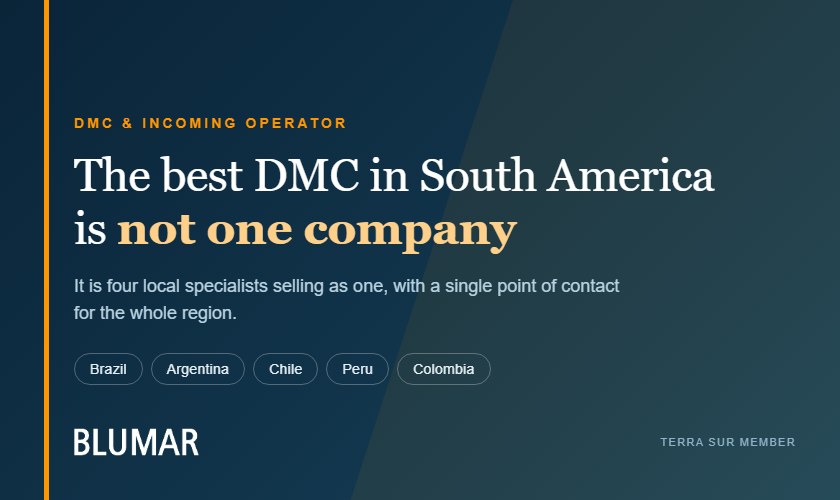
Every few weeks a travel advisor asks us a version of the same question: who is the best DMC in South America? It is a fair question and it deserves a straight answer, including the part of the answer that no supplier likes to say out loud.
Direct answer: there is no single destination management company that operates all of South America with its own teams. The continent is too large and too different from one border to the next, and any operator claiming otherwise is subcontracting somewhere. The model that works in 2026 is an alliance of specialist local DMCs that sells as one company: one contact, one proposal, one payment, with every country operated by the team that lives there. That is what Terra Sur is, formed by Blumar in Brazil, Alchemy DMC in Argentina and Chile, Coltur in Peru and Colombian Journeys in Colombia.
Why one DMC for the whole continent is the wrong thing to look for
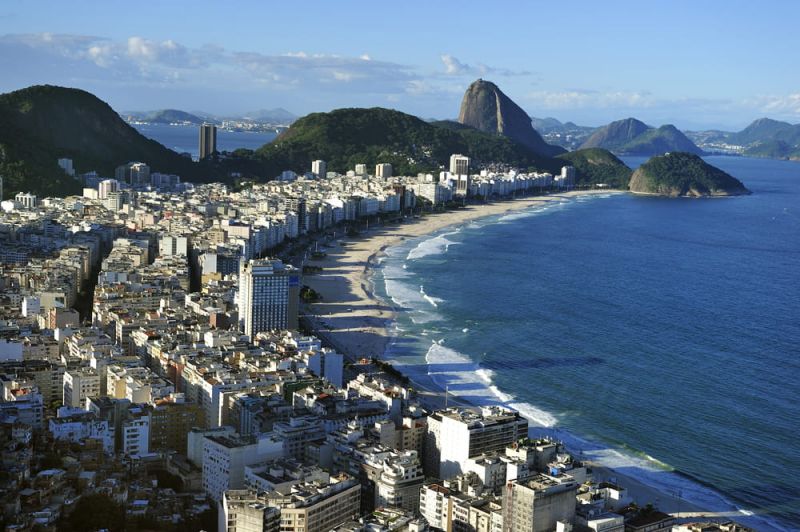
Photo: T photography / Shutterstock.com
South America is not a market. It is a dozen of them. Chile and Peru sell on altitude, logistics and archaeology; Argentina on wine, ice fields and city culture; Brazil on a coastline longer than the distance from Lisbon to Moscow, plus the Amazon and the Pantanal. Supplier relationships, guide licensing, domestic air behaviour, park permits and payment rules change entirely at each border.
That reality produces two common failure modes. The first is the single-country DMC that accepts the whole itinerary anyway and quietly passes the other legs to whoever answers the email. The second is the large international operator with a slick regional brochure and no one on the ground, which works until a flight cancels in Cusco at midnight. Both look identical in a proposal document. They stop looking identical the moment something goes wrong.
Eight things worth checking before you commit
Reputation is hard to compare. These eight are not, and an honest DMC will answer all of them in one email.
Three ways to buy South America, side by side
Most proposals you receive come from one of three structures. The difference only becomes visible under pressure, which is exactly when your client is watching.
| Single-country DMC | Global one-stop operator | Alliance of local DMCs | |
|---|---|---|---|
| Who operates on the ground | Own team in one country, partners elsewhere | Local suppliers contracted per trip | Own team in every member country |
| People you deal with | One per country you add | One, with no local authority | One, with authority across the region |
| Proposals and invoices | One set per country | One set | One set for the whole region |
| Leverage with hotels | Strong at home, thin abroad | Depends on volume that year | Strong in every member country |
| When something goes wrong at 2am | Depends which border you are on | Escalates to a head office in another time zone | The team that contracted the supplier answers |
| Best suited to | Single-country trips | Simple, low-touch itineraries | Multi-country and high-touch programmes |
How the alliance model works in practice
Terra Sur was created out of relationships that already existed. Blumar had worked for years with the same handful of DMCs across the region, chosen for shared standards rather than convenience, and the alliance simply formalised it. Each member remains fully responsible for its own operation, which is the point: nobody is reselling a country they do not run.
What that means for the agency sitting on the other side of the proposal:
- One dedicated contact for the entire itinerary, backed by the specialist team in each country, so nothing is lost between borders.
- One proposal and one payment for the whole region, instead of several invoices, deadlines and international transfer fees.
- No surcharge for the convenience. Each member prices its own operation directly, so the single point of contact costs nothing extra.
- Teams on the ground in every destination, available around the clock from the first arrival to the final departure.
- Offices you can actually walk into in Rio de Janeiro, Buenos Aires, Santiago, Lima, Cusco and Bogotá. Uruguay is covered through Alchemy in Argentina.
What the Brazil partner brings
Brazil is usually the longest and most complex leg of a South America itinerary, so it is worth being specific about who operates it. Blumar has been making Brazil easy to sell since 1985, from a head office in Rio de Janeiro with nationwide operational coverage, across FIT and group leisure, incentives, congresses and cruises.
A few things behind those numbers. Commercial representation runs through six markets, covering the United States, Canada and Mexico, the United Kingdom, Italy, South Africa, and New Zealand and Australia, so partners are briefed in their own time zone. Proposals come as NET or gross, in white label material when you re-sell, with a transparent breakdown in US dollars and commission on gross pricing paid within fourteen days of the trip ending. There are no generic packages: every itinerary is built from scratch.
Product knowledge is first hand rather than catalogue deep. Blumar specialists personally inspect the hotels, boats and experiences they sell, and the reports go to partners through the client area alongside NET rates in USD, online reservations, an image and video bank, trainings and ready-to-sell itineraries. The portfolio covers five essential destinations, Rio de Janeiro, Iguassu Falls, Salvador, the Amazon and the Pantanal, plus seventeen beyond the classics, from Lençóis Maranhenses and Fernando de Noronha to Chapada dos Veadeiros and the southern wine region.
On capacity, the clearest evidence is recent. Blumar Congressos & Eventos was the official agency of the 82nd IATA Annual General Meeting, held in Rio de Janeiro from 6 to 8 June 2026. Hosted by LATAM Airlines Group, it gathered around 1,500 industry leaders, government officials and media, and brought the summit back to South America for the first time since 1999.
Sustainability is handled the same way, as a set of named commitments rather than a paragraph: the For a Better World programme supports Conexão do Bem in Rio's public hospitals, the Projeto Arara Azul in the Pantanal, the Ibiti Project in Minas Gerais, Instituto Vida Livre and Favela Orgânica, and the company has joined Tomorrow's Air on carbon removal.
How to brief a South America DMC and get a usable proposal
The quality of the first proposal is decided almost entirely by the quality of the brief. Six lines are usually enough.
Red flags in a South America proposal
- A single price for a multi-country trip with no breakdown by country or service.
- Nobody can name the local operator for a leg, or the name changes between emails.
- The emergency contact is a head office switchboard in Europe or North America.
- Hotels quoted that the team has never visited, described in words copied from the hotel's own website.
- Memberships claimed but not listed in the association's public directory.
- Internal flights left as to be confirmed within sixty days of travel in high season.
So, which is the best DMC in South America?
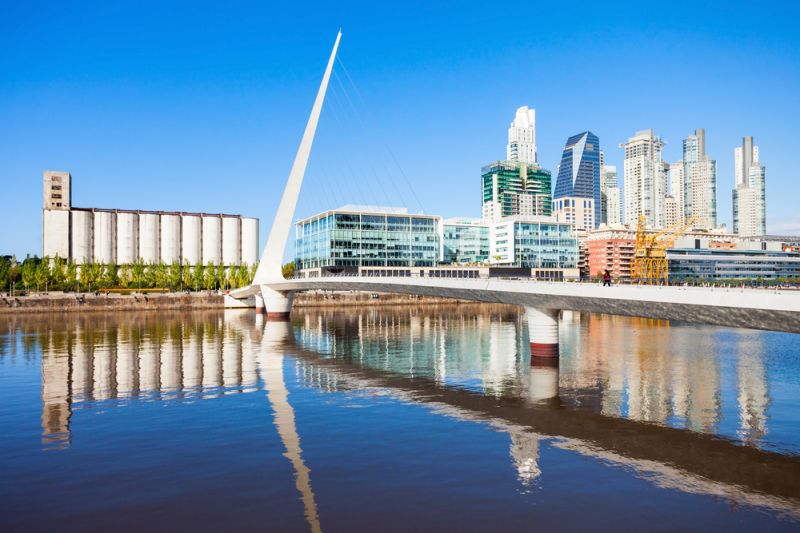
Photo: saiko3p / Shutterstock.com
The honest answer is that the best DMC in South America is the best DMC in each country, working under one structure so you only have to manage one relationship. Judge it on the eight criteria above rather than on adjectives, ask for the two references that most resemble your own programme, and check the memberships yourself. If your itinerary includes Brazil, that is the leg we operate ourselves, and you can start with our guide on how to work with a DMC in Brazil or with what to look for in a Brazilian DMC.
To open a multi-country request across Brazil, Argentina, Chile, Peru, Colombia or Uruguay, one message to Terra Sur reaches all of them at once.
Posts you might also be interested in:
- Best Destinations in Southeastern Brazil to Visit in the Summer of 2026
- Discover the Largest Waterfalls in Brazil with Blumar DMC
- Discover the Best Ecotourism Destinations in Brazil with Blumar DMC
- Luxury Travel Operator Brazil: Why Blumar DMC is the Premier Choice
- DMC for Cultural Experiences Brazil: Why Blumar DMC is Your Trusted Partner
- Terra Sur, Perfect Journeys Across South America
FAQ - Best DMC in South America
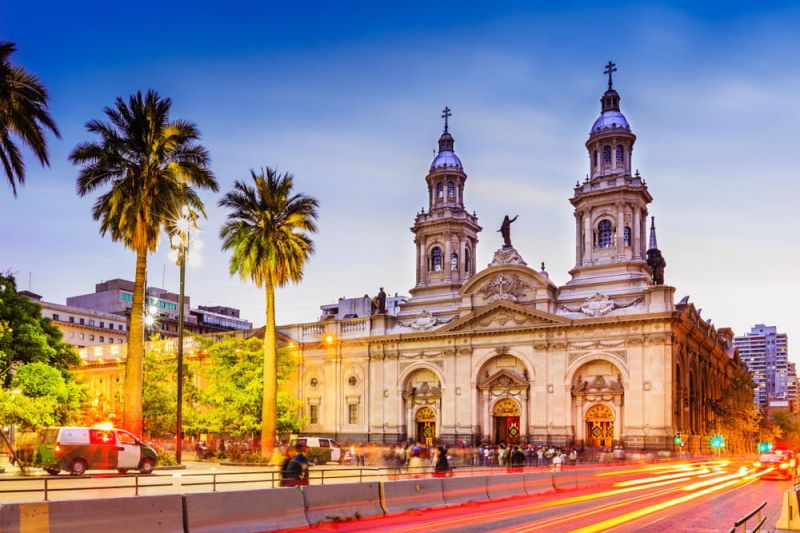
Foto: SCStock / Shutterstock.com
1. What is the best DMC in South America?
There is no single DMC that operates every country in South America with its own teams, so the best answer is an alliance of specialist local DMCs that sells as one company. Terra Sur works this way, with Blumar operating Brazil, Alchemy DMC operating Argentina and Chile, Coltur operating Peru and Colombian Journeys operating Colombia. You get one contact, one proposal and one payment, while each country is run by the team based there.
2. What does a DMC actually do?
A destination management company designs and operates the ground programme in its destination: hotels, transfers, guides, experiences, restaurant reservations, domestic flights, event logistics and support while your clients are travelling. It sells to travel agencies, tour operators and corporate planners rather than directly to travellers, which is why its rates are usually NET.
3. Is it cheaper to book each country separately?
Rarely, once the real costs are counted. Contracting one DMC per country means several proposals, several deadlines, several invoices and several international transfer fees, plus the hours spent reconciling them. In the Terra Sur model there is no surcharge for the single point of contact, because each member prices its own operation directly.
4. How do I check that a DMC is genuinely accredited?
Ask which associations it belongs to and then look it up in the association's own public member directory. Virtuoso, USTOA, LATA, IATA and IGLTA all publish theirs. A membership that cannot be found in the directory is not a membership.
5. Which countries does Terra Sur cover?
Brazil, Argentina, Chile, Peru and Colombia are operated by the member DMCs, and Uruguay is covered through Alchemy DMC in Argentina. The alliance has offices in Rio de Janeiro, Buenos Aires, Santiago, Lima, Cusco and Bogotá.
6. Who answers if something goes wrong during the trip?
The team that contracted the supplier, in the country where the problem is happening and in local time. Each member provides 24/7 on-the-ground support and a dedicated emergency number for its own country, which avoids the delay of escalating to a head office in another time zone.
7. How far in advance should a multi-country itinerary be requested?
For high season, or for anything involving the Galápagos-style capacity constraints of small lodges in the Amazon, the Pantanal or Patagonia, four to six months is comfortable and three is workable. Internal air and small properties are what run out first, not the big city hotels.
8. Do DMCs work with individual travellers?
Not usually. A DMC is a business-to-business partner for travel agencies, tour operators, event agencies and corporate planners. Individual travellers reach the same operations through their own advisor, who holds the relationship and the commercial terms.
9. What is the difference between a DMC, a travel agency and a PCO?
The travel agency owns the client relationship and sells the trip. The DMC designs and operates the programme on the ground in the destination. A PCO, or professional congress organiser, runs the congress itself, including scientific programme, registration and sponsorship. On large events the three work together.
10. Can one DMC handle a corporate incentive across several countries?
Yes, under the alliance model. The programme is designed as one document, the budget is presented as one breakdown, and each country is operated by its local team, which is what keeps standards consistent across borders on incentive programmes and congresses.
11. What should a good DMC proposal always include?
A breakdown by country and by service rather than a single number, named hotels and room categories, named local operators for each leg, what is and is not included, the emergency contact in destination, and the date the quoted space is released.
12. Why does Brazil usually need its own specialist?
Brazil is a continent-sized country with domestic air distances measured in hours, regional differences in season and infrastructure, and a supplier market that rewards long relationships. That is why Terra Sur has a dedicated Brazilian member rather than treating the country as one more destination on a regional list.